
Project Area
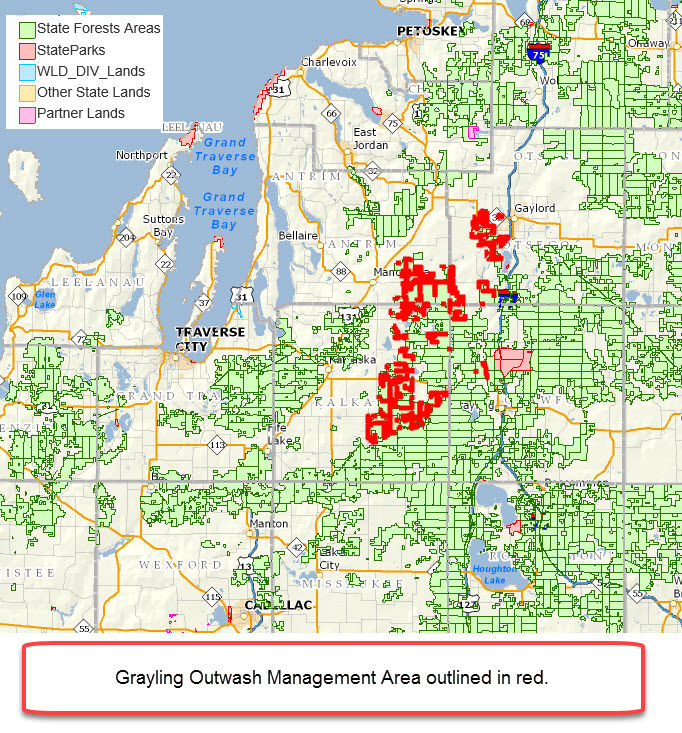
 The Grayling Outwash Management Area is located in northern Lower Michigan, generally between Gaylord and Kalsaska. It occupies the high plains of Otsego, Antrim, Crawford and Kalkaska Counties and includes approximately 65,000 acres of State Forest land. As the name suggests, this landscape is part of a large, relatively sandy outwash plain. Historically fires were very common and shaped the vegetation of the area. Currently, areas of aspen, red pine, and upland hardwoods cover the majority of the state forest land. The Manistee River, a state-designated Natural River, runs through this MA. There is also extensive natural gas development around this landscape, along with ORV/snowmobile recreation and the North Country Trail.
Management Goals
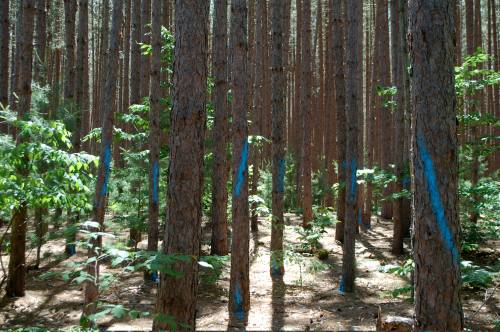
At the adaptation workshop, the DNR foresters considered the management goals and objectives for three primary forest cover types: aspen, red pine, and northern hardwoods. According to the 2013 Regional State Forest Management Plan for Northern Lower MIchigan (available below), some of the specific management objectives for these cover types in this MA include:
Aspen:
- balance age classes, with an emphasis on the current 40-49 year age class
- conduct final harvest on 3,000 acres over a 10-year period
- maintain aspen acreage through time (though some decrease is allowable as transition occurs)
Red pine:
- balance age classes by regenerating about 25% of red pine, particularly focusing on the 40-59 age class
- conduct thinning on about 50% of the red pine acrea
- expand red pine acres by planting in areas where other forest types are not productive.
Northern hardwoods:
- retain species diversity, particularly mast species like oak to replace beech
- establish and rerecuit regeneration
- convert from even-aged to uneven-aged stand structure on high-quality sites
Climate Change Impacts
For this Management Area, the DNR foresters thought the most important anticipated climate change impacts included:
reduced soil moisture in the summer, which will make it difficult to establish red pine seedlings
early spring thaws, followed by frosts, particularly for hardwood species like oaks
forest pathogens like beech bark disease may be more damaging when forests are stressed from climate factors
Challenges and Opportunities
Climate change will present challenges and opportunities for accomplishing the management objectives of this project, including:
Challenges
Drought will make it more challenging to establish red pine seedlings and add stress to aspen and northern hardwoods
Aspen may decline on drier sites, and balancing age classes will be more difficult with shifting forest health concerns
Insects and diseases may limit the ability to replace hard mast species
Opportunities
Red pine could expand to sites that become unfavorable for hardwoods or aspen
Longer growing seasons could help regeneration grow past deer browse height and create opportunities for southern tree species
Bigtooth aspen may perform better than quaking aspen in mixed stands
Adaptation Actions
The DNR foresters used the Adaptation Workbook to develop several adaptation actions for this project, including:
Area/Topic
Approach
Tactics
Northern Hardwoods
Patch cuts to create canopy gaps create variable structure and encourage regeneration in northern hardwood stands.
9.1. Favor or restore native species that are expected to be adapted to future conditions.
9.7. Introduce species that are expected to be adapted to future conditions.
9.7. Introduce species that are expected to be adapted to future conditions.
Conduct limited assisted migration planting in northern hardwoods stands as a research project.
Red Pine
Consider planting red pine in the fall to avoid summer heat if spring planting failure becomes a concern, and plant containerized stock that might be better at withstanding drought stress.
Plant red pine on a range of sites across the habitat spectrum for the species, to maintain options for future sites.
9.1. Favor or restore native species that are expected to be adapted to future conditions.
9.3. Guide changes in species composition at early stages of stand development.
9.3. Guide changes in species composition at early stages of stand development.
Expand red pine to other cover types if aspen or northern hardwoods stands show signs of decline.
Monitoring
Project participants identified several monitoring items that could help inform future management, including:
compare the success of planting large saplings for species like oak against planting smaller seedlings
compare the growth and survival of southern tree species in assisted migration experiments against "native" species
assess oak and beech vigor to ensure steady or increasing vigor in northern hardwoods stands
Project Documents
NLP_MA13-GraylingOutwashMA_Brief.doc
(157 KB)
NLPMgmtPlanSec4MA13GraylingOutwash.pdf
(1.95 MB)
Learn More
Keywords
Landscape-scale planning
Management plan
Plantations
Regeneration
Upland conifers
Upland hardwoods